
Every company has competitors. Some you know about, some you don’t. You know you need to “differentiate” - but the question is: from what, toward what, and on whose terms?
Competitive positioning analysis answers that question. It examines where your brand stands relative to competitors and - more importantly - where it should move. Not just what competitors are doing, but what their actions mean for your strategy.
It has been done, in various forms, since the mid-twentieth century. But the work itself - what it involves, what frameworks underpin it, how it differs from competitor monitoring or messaging workshops - is surprisingly under-documented. This article is an attempt to fix that.
Positioning: A Brief Intellectual History
The concept of “positioning” in marketing has deeper roots than most practitioners realise.
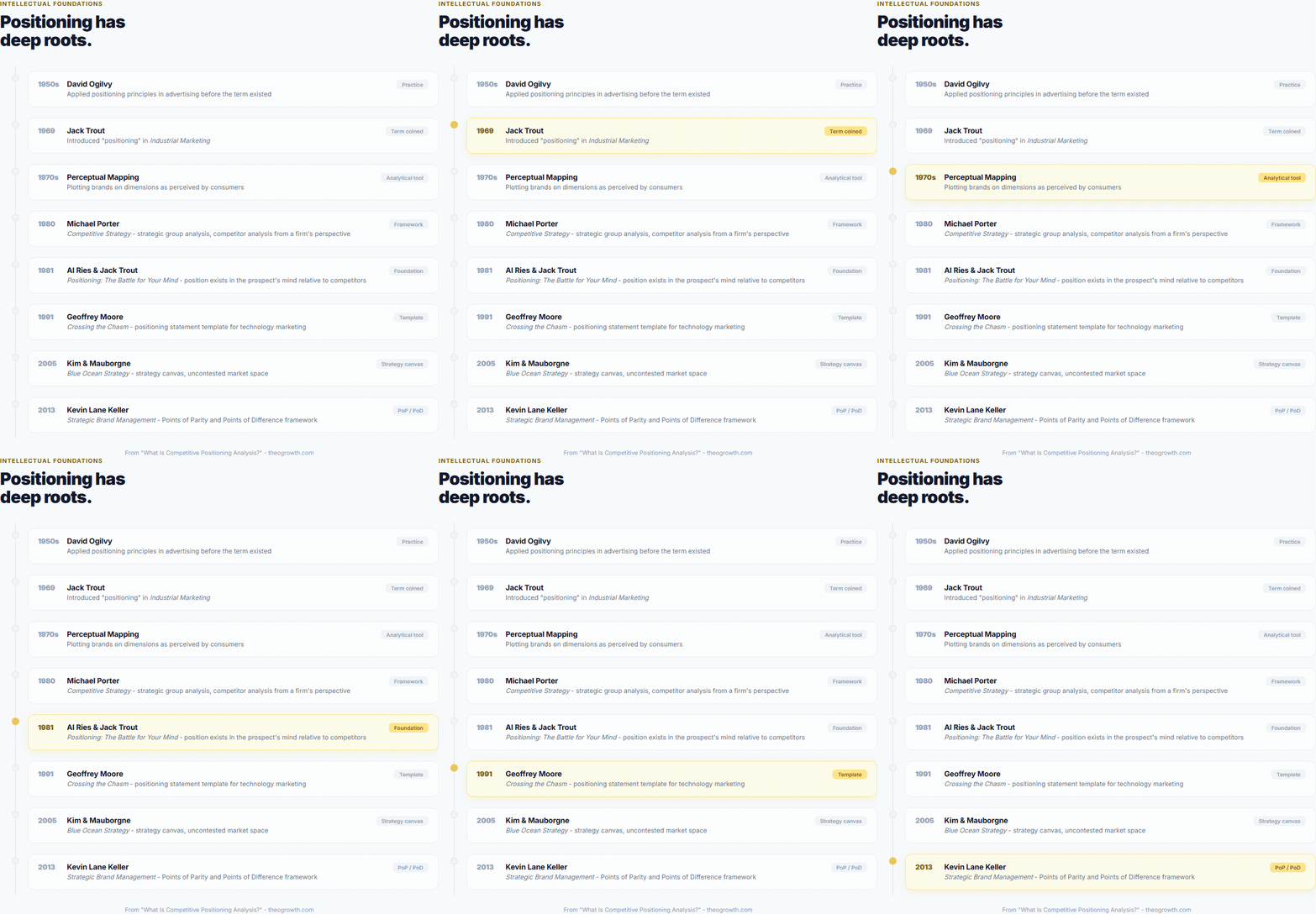
David Ogilvy applied positioning principles in advertising from the 1950s. Jack Trout introduced the term to marketing literature in a 1969 article in Industrial Marketing, and together with Al Ries published the landmark Positioning: The Battle for Your Mind in 1981. Their core argument - that
a brand’s position exists in the prospect’s mind relative to competitors, not in isolation - remains foundational.
But positioning is not only Ries and Trout. It is embedded in the widely-taught STP framework (Segmentation, Targeting, Positioning), which treats positioning as the culmination of strategic marketing work. Kevin Lane Keller’s Strategic Brand Management (2013) formalised the Points of Parity and Points of Difference framework - the idea that a brand must establish credibility on shared category expectations (parity) while asserting distinctive value (difference). Michael Porter’s Competitive Strategy (1980) contributed strategic group analysis and a competitor analysis framework that explicitly examines competitive dynamics from a firm’s perspective. Kim and Mauborgne’s Blue Ocean Strategy (2005) introduced the “strategy canvas” and the concept of “uncontested market space” - areas where no competitor competes effectively.
The analytical toolkit is similarly established: perceptual mapping (1970s), which plots brands on two or more dimensions as perceived by consumers; the Ansoff Matrix for growth direction; the BCG Matrix for portfolio positioning; and Geoffrey Moore’s positioning statement template from Crossing the Chasm (1991), still the most widely-used format for articulating a competitive position in technology marketing.
These are not competing frameworks. They are complementary lenses on the same problem: where should this brand stand, relative to alternatives, in the mind of a specific audience?
What Competitive Positioning Analysis Actually Is
Competitive positioning analysis is the systematic examination of competitive relationships from a specific brand’s perspective - understanding not just who competitors are, but how they compete for the same audiences, value propositions, and market positions - synthesised into strategic direction.
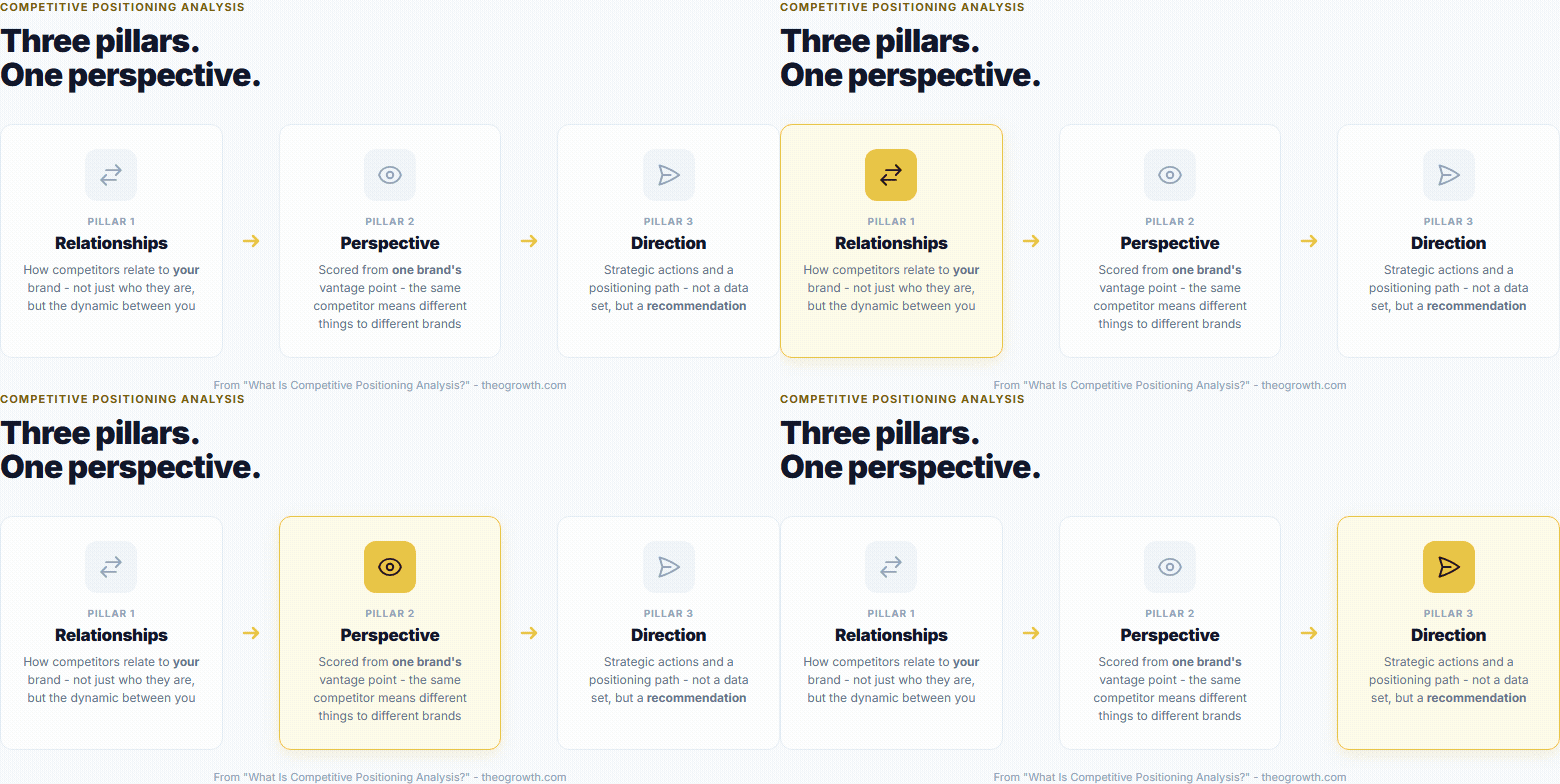
Three words carry the weight: relationships, perspective, and direction.
Relationships because a list of competitors is not analysis. What matters is the competitive dynamic between each competitor and the brand being examined. A competitor that overlaps with your value proposition by 80% is a different strategic problem than one that overlaps by 20% - even if both are in your category. This is the principle Porter articulated in Competitive Strategy, Chapter 3: competitor analysis must be conducted from the perspective of a specific firm.
Perspective because the same competitor can be a direct threat to Brand A and irrelevant to Brand B, even within the same industry. Positioning analysis starts from one brand’s vantage point and assesses every competitive relationship relative to that brand’s specific position, audience, and claims.
Direction because the purpose is not to describe the landscape. It is to recommend where to compete, what to claim, and what to avoid. The deliverable is a strategic starting point - not a data set that requires weeks of additional interpretation.
How to Do Competitive Positioning Analysis: 5 Steps
Whether done manually or assisted by software, competitive positioning analysis follows a recognisable sequence. Here is how the process works in practice.
Step 1: Start with your own brand
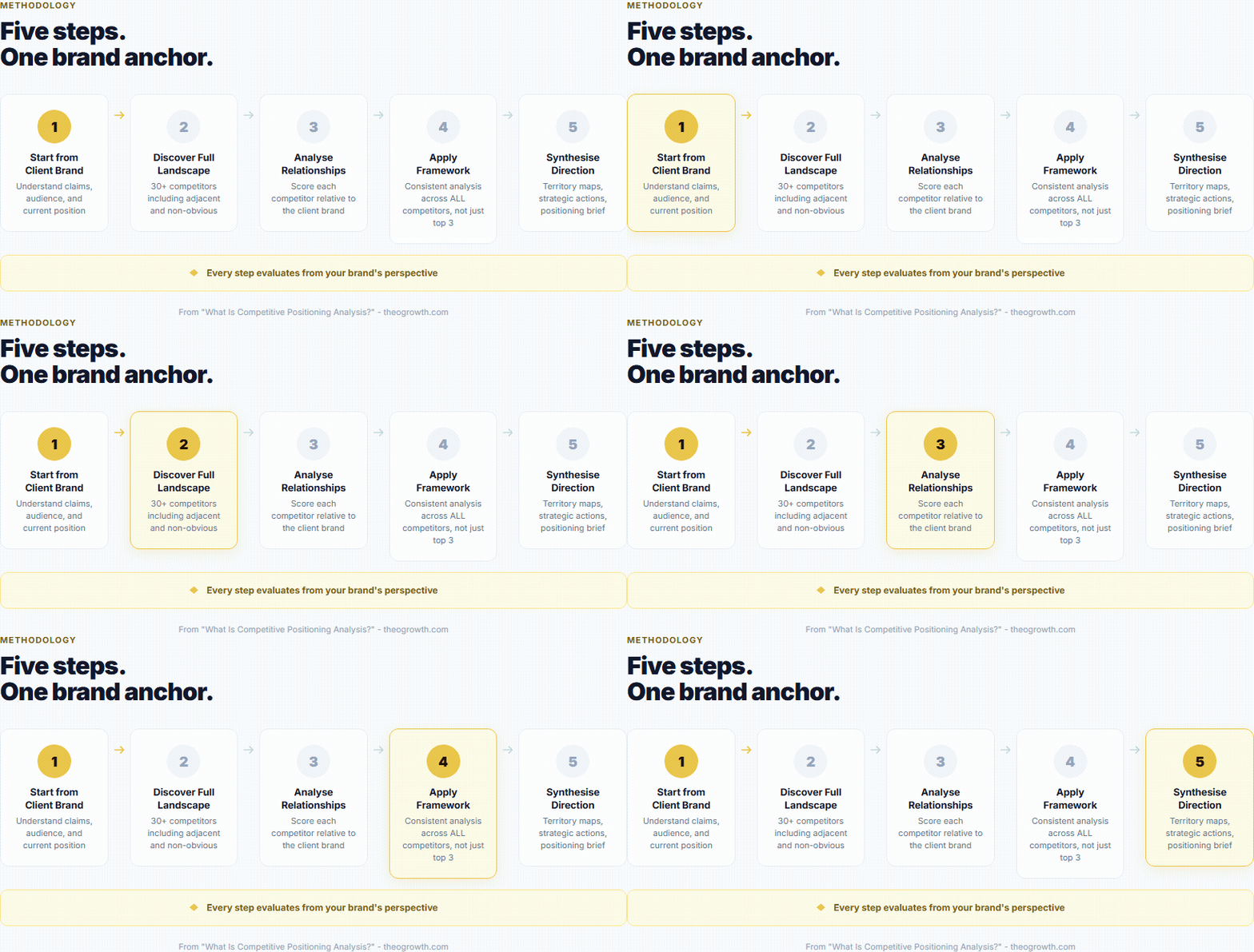
Before looking at any competitor, get clear on what your brand claims, who it targets, and how it currently communicates. Write it down. This becomes the lens through which all competitors will be evaluated.
What to do: Document your current value proposition, target audience, and key messaging themes. Be honest about what you actually claim today - not what you aspire to.
Step 2: Map the full competitive landscape
Not the three competitors you already know about. The full landscape - including adjacent category players, emerging entrants, and what Porter called “substitute products” and “potential entrants” in his Five Forces framework. A comprehensive analysis often identifies 10+ competitors.
What to do: List every company a prospect might consider instead of you. Include direct competitors, indirect alternatives, and the “do nothing” option. Check search results, review sites, industry directories, and ask your sales team who comes up in conversations.
Step 3: Analyse competitive relationships, not just entities
For each competitor, examine how they relate to your brand specifically: audience overlap, messaging similarity, capability emphasis, value proposition convergence. A competitor that overlaps with your value proposition by 80% is a different problem than one that overlaps by 20%.
What to do: For each competitor, assess how much their audience, claims, and positioning overlap with yours. Score the relationship, not just the competitor. The same competitor can be a direct threat to one brand and irrelevant to another.
Step 4: Apply a consistent framework across the full set
Most competitive research analyses three competitors deeply and ignores the rest. Rigorous positioning analysis applies the same assessment to every competitor - because strategic threats often come from the non-obvious players.
What to do: Use the same dimensions (audience overlap, messaging similarity, value proposition alignment) for every competitor on your list. Resist the urge to deep-dive on familiar competitors and skim the unfamiliar ones.
Step 5: Synthesise into strategic direction
This is the step that separates positioning analysis from competitive monitoring. Raw data becomes territory maps. Entity profiles become relationship patterns. Scattered observations become a positioning recommendation.
What to do: Identify which positioning territories are open, contested, or saturated. Decide where to compete. Draft a positioning direction that includes what you claim, who you claim it for, and why it is defensible.
What the Output Looks Like
A competitive positioning analysis typically produces some combination of the following. The exact format varies by practitioner - some produce written briefs, others create visual maps, some combine both.
Positioning territory mapping. Building on the tradition of perceptual mapping and the “strategy canvas” from Blue Ocean Strategy, territory mapping categorises strategic spaces in the market by occupancy:
Owned territories - positions already claimed and defensible (analogous to “red ocean” positions held by incumbents)
Unoccupied territories - positions no competitor has claimed convincingly (analogous to “blue ocean” uncontested space)
Contested territories - positions where multiple competitors fight for the same ground
Saturated territories - positions that cannot be held due to competitive density or market dynamics
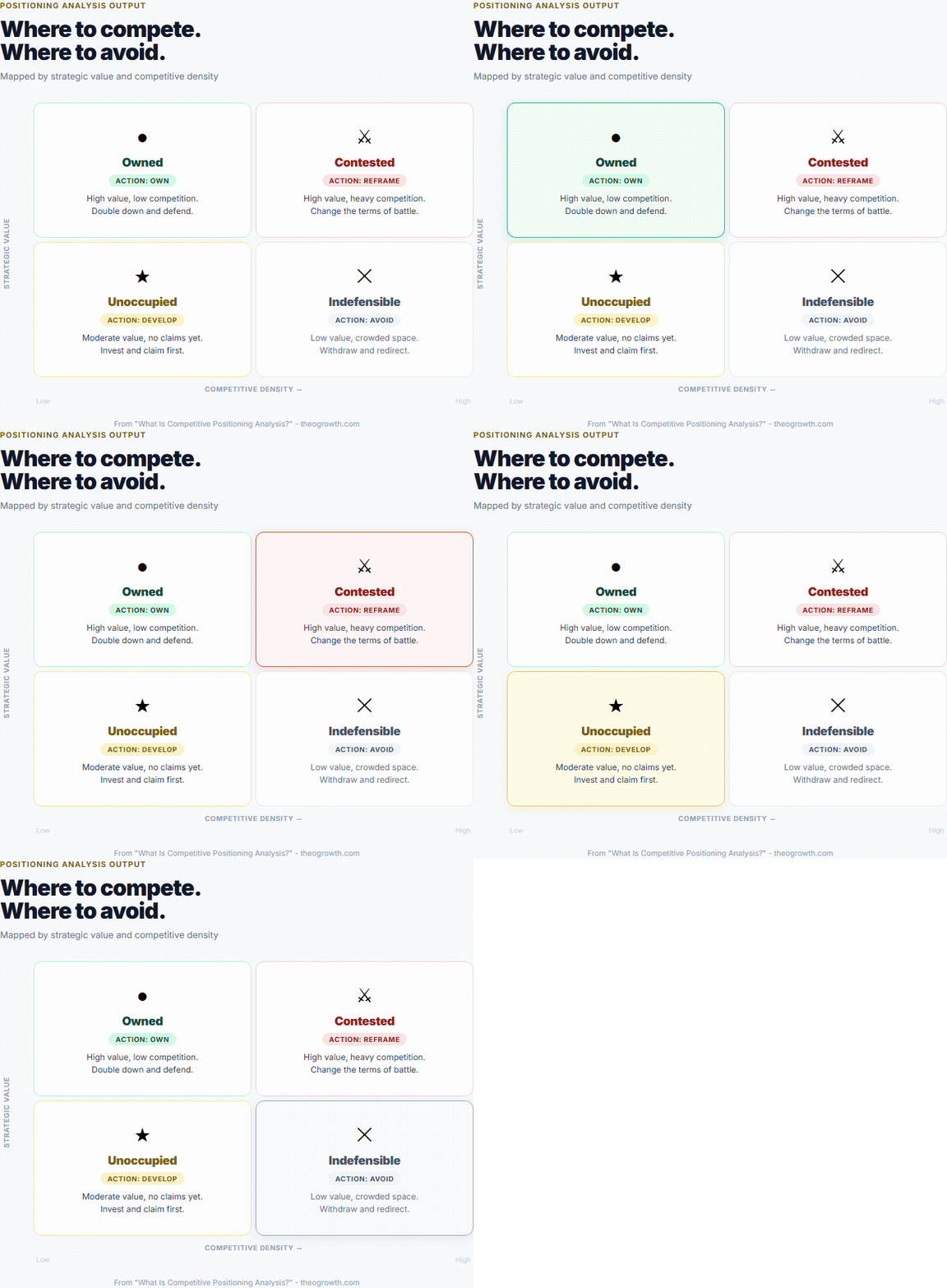
Strategic direction. Drawing on established competitive response frameworks (cf. Porter’s generic strategies, the Ansoff Matrix), the analysis recommends a response for each territory:
Defend - strengthen a held position
Reframe - change the terms of competition in a contested space (related to Blue Ocean’s concept of “value innovation”)
Develop - invest in claiming an unoccupied territory
Avoid - withdraw from positions that cannot be won
Directional recommendation. Where the brand sits today, where it should move, and the strategic pillars that support the shift. Often expressed as a FROM-TO statement, building on the positioning statement format popularised by Geoffrey Moore.
Messaging convergence analysis. Where competitor messaging has collapsed into sameness - the zones where every brand sounds identical, creating opportunity for differentiation. This builds on Keller’s Points of Parity vs. Points of Difference framework.
Competitive relationship mapping. How each competitor relates to the analysed brand across multiple dimensions: audience overlap, value proposition alignment, and competitive dynamic patterns. This extends the strategic group analysis framework introduced by Porter (1980) and Hunt (1972).
Competitive Positioning in Practice: 3 Examples
Abstract frameworks are useful. Seeing how brands applied them is better. Here are three companies that used competitive positioning analysis - whether formally or instinctively - to find a winning position.
Liquid Death: water in a contested market
The bottled water market is one of the most saturated in consumer goods. When Liquid Death launched in 2019, every obvious positioning territory was taken: health and purity (Evian), premium taste (Fiji), convenience (Dasani, Aquafina), sustainability (boxed water brands).
A competitive positioning analysis of the water category would have revealed that every major player occupied the same emotional territory: clean, calm, wellness-oriented. The entire category sounded the same.
What they did: Instead of competing on purity or price, Liquid Death claimed the unoccupied territory of “entertainment brand that happens to sell water.” Tallboy aluminium cans, punk-rock branding, a tagline (“Murder Your Thirst”) that deliberately rejected every convention in the category. They identified a messaging convergence zone - where every competitor sounded identical - and positioned as far from it as possible.
The positioning lesson: When every competitor occupies the same territory, the biggest opportunity is often the position nobody would expect. Positioning analysis identifies these gaps by mapping where messaging has collapsed into sameness.
HubSpot: reframing a contested space
HubSpot entered the CRM market in 2014, years after Salesforce had established dominance. Competing head-to-head with Salesforce on enterprise features or scale would have been expensive and probably futile.
A competitive positioning analysis of the CRM landscape would have shown Salesforce owning the “enterprise power” territory, with most competitors (Zoho, Pipedrive, Freshsales) competing on price or niche features within the same paradigm.
What they did: HubSpot reframed the territory entirely. Instead of “simpler CRM” (the mid-value zone against Salesforce), they positioned around a completely different axis: “grow better.” They bundled CRM with marketing, sales, and service tools into a free-to-start platform and repositioned the competitive question from “which CRM has more features?” to “which platform helps growing companies actually grow?”
The positioning lesson: When the dominant competitor owns a territory, you can reframe the terms of competition rather than fighting on their ground. This is the “reframe” strategic action in territory mapping - changing what the market competes on, not just where you sit on the existing axes.
Notion: expanding from a niche to a platform
When Notion launched, the productivity tool space was crowded: Evernote for notes, Trello for project management, Google Docs for collaboration, Confluence for team wikis. Each competitor owned a narrow, well-defined territory.
A competitive positioning analysis would have revealed that the space was fragmented by function - each tool did one thing well. But no tool had claimed the territory of “all-in-one workspace.” More importantly, users were tired of switching between six apps to do their work.
What they did: Notion positioned itself across the boundaries that existing competitors had drawn. Instead of being “a better notes app” or “a better wiki tool,” they claimed “one tool for everything.” They developed an unoccupied territory - the integrated workspace - that sat between existing category definitions.
The positioning lesson: Positioning analysis reveals not only who occupies which territory, but how the territories themselves are defined. Sometimes the biggest opportunity is to redraw the map entirely - claiming space that exists between established categories rather than within them.
What Positioning Analysis Is Not
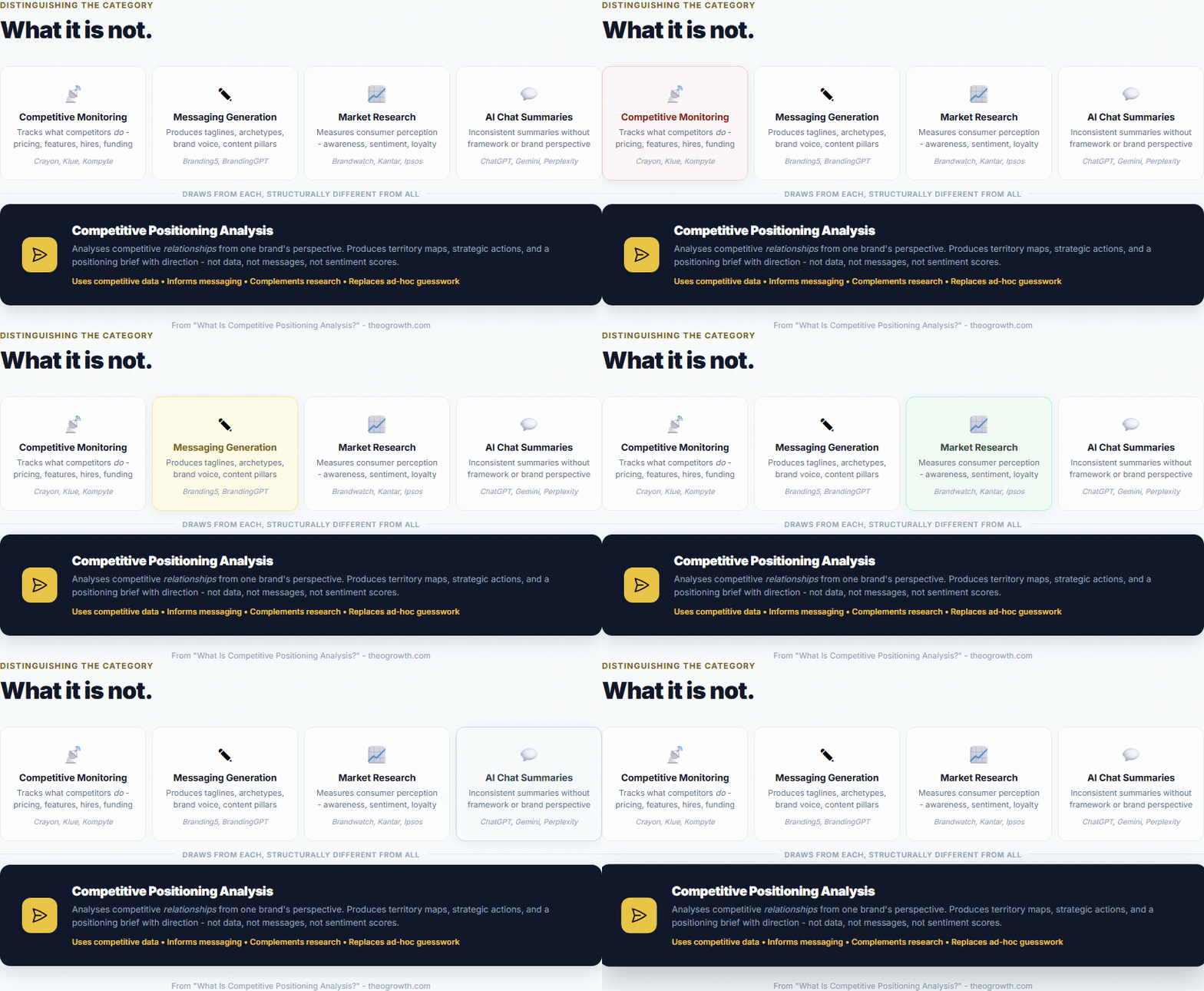
The term “positioning” is applied so loosely in marketing that it helps to draw clear boundaries.
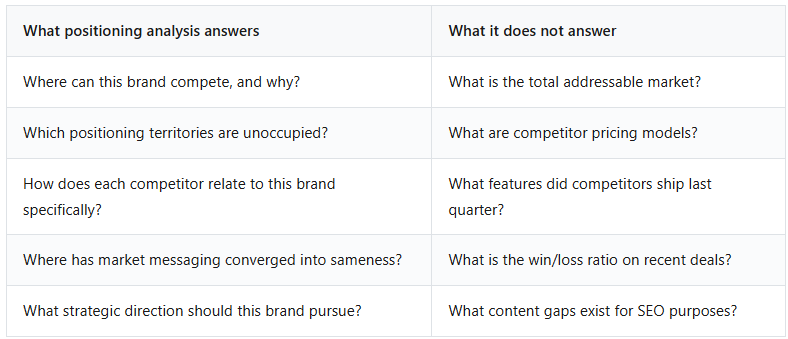
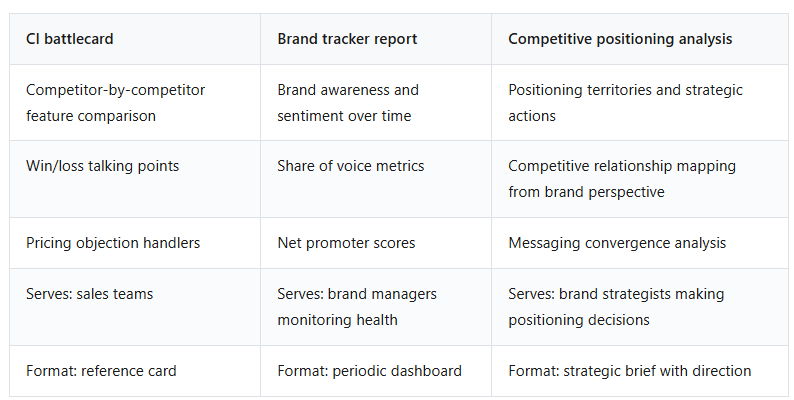
It is not competitive monitoring. Monitoring tracks what competitors do - pricing changes, feature launches, hiring patterns, press releases. This is valuable data collection, and some of these signals genuinely affect positioning. But tracking what a competitor launched is different from interpreting why they launched it, what territorial claim it represents, and how that changes the competitive dynamic for your brand. The same data serves both functions - the difference is the lens applied and the output produced.
It is not messaging generation. Several tools branded as “brand positioning tools” produce taglines, archetypes, and content calendars. That is execution, not strategy. Positioning is the strategic choice that precedes messaging - as Ries and Trout argued, the position must exist in the prospect’s mind before any message can reinforce it.
It is not market research. Survey-based brand research (Kantar, Ipsos) measures how consumers currently perceive a brand. This is retrospective and audience-facing. Positioning analysis is forward-looking and competitor-facing: where should the brand move, given the competitive terrain?
It is not an AI chat session. AI can do competitive positioning analysis, but general-purpose tools struggle with it. One conversation can't hold enough context to treat even 5+ competitors evenly. Multiple sessions lose consistency - each starts fresh with no shared framework. Either way, some competitors get more depth than others, some details are overemphasised, others quietly missed - and the output reads well enough that you can't tell which is which. The work can be done with AI, but doing it rigorously takes hundreds of orchestrated steps.
The Gap Between Theory and Tooling
Competitive positioning analysis as a practice is well-established. The tooling for it is not.
The competitive intelligence market is valued at USD 0.59 billion in 2025, projected to reach USD 1.46 billion by 2030 at 19.96% CAGR (Mordor Intelligence, 2025). But that growth is driven predominantly by sales enablement. The dominant CI tools - Crayon, Klue, Contify - are optimised for battlecards, win/loss analysis, and competitor monitoring.
The CI discipline is broader than this. The Strategic Consortium of Intelligence Professionals (SCIP) distinguishes between tactical CI and strategic CI. Porter’s competitor analysis framework in Competitive Strategy Chapter 3 is explicitly relationship-based. But the tools most strategists encounter in practice are built for the tactical end.
On the other end, brand tracking platforms (Brandwatch, Meltwater) measure current perception, not competitive positioning opportunity. Traditional research firms (Kantar, Ipsos) offer deep perception research but through methodologies that take weeks and cost tens of thousands of pounds.
In the middle: brand strategists doing the work manually. Reading competitor websites. Mapping messaging patterns. Identifying territorial claims. Synthesising findings into strategic recommendations by hand. The GRIT Insights Practice report found that brand positioning is among the top business issues affected by insights work (cited by 29% of insights buyers), yet the tools available for this specific job are sparse.
The competitive intelligence market is well-served at the enterprise level - platforms like Klue and Crayon offer deep tracking, mature workflows, and sales enablement at scale. What's been underserved is the positioning step: taking competitive data and turning it into strategic direction - territory maps, positioning briefs, a recommendation for where to compete and why. Most practitioners still do this work manually, in spreadsheets and slide decks, because the tools that exist either stop at monitoring or start at six-figure budgets. THEO was built to close that gap - structured positioning analysis, per project, for the person doing the strategic thinking. The space is early and evolving.
Who Needs Competitive Positioning Analysis?
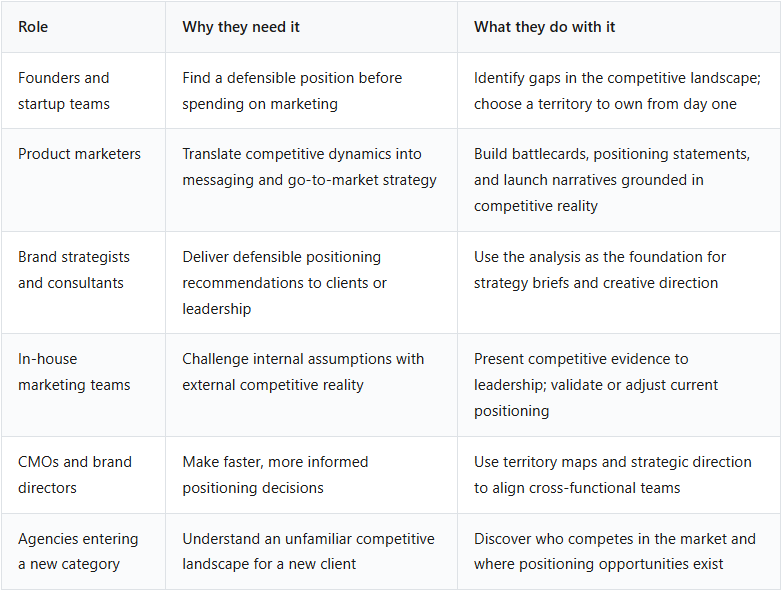
The common thread: anyone whose job involves deciding where a brand should stand relative to competitors - whether that brand is a Fortune 500 company or a startup with a team of five.
Frequently Asked Questions
What is the difference between competitive positioning analysis and competitive intelligence?
CI as a discipline is broad - encompassing both tactical monitoring and strategic analysis (Porter, SCIP). In practice, the dominant CI tools focus on sales enablement: battlecards, win/loss analysis, competitor alerts. Competitive positioning analysis asks a different question (“where can this brand win?”) and produces a different output (strategic direction vs. monitoring dashboards). The distinction is sharpest at the tooling level. For a detailed comparison, see CI vs. Positioning Strategy.
What tools support competitive positioning analysis?
This is still an emerging space. Dedicated platforms include SmokeLadder (positioning and messaging scoring) and Competely (AI-powered competitive analysis). Traditional approaches - manual competitive audits by strategy consultants using established frameworks (perceptual mapping, strategic group analysis, Blue Ocean strategy canvas) - remain common. For a full breakdown, see How to Choose Tools for Brand Positioning Work.
How long does a competitive positioning analysis take?
Hours to weeks, depending on methodology and scope. Manual approaches for a broad competitive set can take weeks. Tool-assisted approaches accelerate data collection but still require human interpretation. Quick surface-level scans produce unreliable conclusions because they miss messaging nuance, territorial claims, and competitive relationship patterns.
Can AI replace positioning analysis?
AI can accelerate the research and data processing that feeds positioning analysis - scanning competitor communications, identifying patterns, scoring alignment. But strategic positioning decisions require human judgment: choosing which territory to claim, accepting the trade-offs of that choice, and committing to a direction. AI generates options; strategists make choices.
Related reading
Competitive Intelligence vs. Positioning Strategy: Different Jobs, Different Tools - Why tracking competitors is not the same as understanding where to compete.
How to Choose Tools for Brand Positioning Work - Four jobs, four categories of tools, and which one serves which task.
Everyone Calls It “Strategy.” But Which Layer Do You Actually Mean? - A 5-layer map showing where positioning decisions actually happen.
References
Academic and Industry Foundations
Ries, A. & Trout, J. (1981). Positioning: The Battle for Your Mind. McGraw-Hill. - The foundational work on positioning theory.
Porter, M.E. (1980). Competitive Strategy: Techniques for Analyzing Industries and Competitors. Free Press. - Foundation of competitive analysis; Chapter 3 on relationship-based competitor analysis.
Keller, K.L. (2013). Strategic Brand Management: Building, Measuring, and Managing Brand Equity. 4th ed. Pearson. - Points of Parity / Points of Difference framework.
Aaker, D.A. (1996). Building Strong Brands. Free Press. - Brand identity model and competitive positioning.
Kim, W.C. & Mauborgne, R. (2005). Blue Ocean Strategy. Harvard Business Review Press. - Strategy canvas and “uncontested market space.”
Moore, G. (1991). Crossing the Chasm. HarperBusiness. - Positioning statement template.
Kapferer, J.N. (2012). The New Strategic Brand Management. 5th ed. Kogan Page. - Brand identity prism and advanced positioning theory.
Fleisher, C.S. & Bensoussan, B.E. (2015). Business and Competitive Analysis. 2nd ed. FT Press. - 24 established competitive analysis techniques.
Industry Reports Cited
Mordor Intelligence (2025). Competitive Intelligence Tools Market Size & Share Analysis.
Forrester (Q4 2024). The Forrester Wave: Competitive and Market Intelligence Platforms.
Gartner (2024). Market Guide for Competitive and Market Intelligence Tools.
GRIT Insights Practice Report. Greenbook / Insight Innovation Exchange.